A style guide is one of the most critical tools a toy or entertainment brand can develop when it’s ready to enter the world of brand licensing. A style guide ensures that licensed products across all categories are visually-consistent, licensee partners are working efficiently as they develop their products, and the brand is maximizing its impact at retail – but only if it’s developed at the right time, and for the right reasons.
If a toy or entertainment brand creates a style guide too early, they’ve poured resources into assets and guidance that no one needs it yet. If they wait too long, their partners are winging it with their IPs – and it shows in the form of off-model products, disjointed packaging, and frustrated licensees and retailers. The key is knowing when to invest and what kind of style guide a brand actually needs to support a scalable licensing program.
Let’s break it down.
What a licensing program style guide really does
A licensing program style guide isn’t just a mood board or a delivery system for assets – it’s a comprehensive product development toolkit. It provides partners with brand and design assets along with a clear and consistent visual aesthetic, and standardization guidelines to help them design, develop, and produce products that align with the brand – without constantly leaning too heavily on the brand owner’s creative team.
A strong licensing program guide accomplishes three things:
Protects the brand. It defines visual boundaries and illustrates the proper usage of logos, color palette, fonts, and design elements on product and how to implement packaging.
Accelerates design development. Licensee partners move faster when the licensed brand’s assets and standardization guidelines are all in one place.
Scales with consistency. Whether the licensed brand appears in one category or twenty, the visual aesthetic remains cohesive – across all products and packaging that reach retail.
When done right, a licensing program style guide drives the growth of a toy or entertainment brand’s licensing business.
3 Clear signals that it’s time to build a style guide
1. You’re getting interest from licensees, but you’re flying blind
If potential licensee partners are reaching out to license you brand, but your creative team is still scrambling to provide logos and asset files, then you’re way behind. Licensees expect a brand that’s ready to plug into their process. If they have to rely on you to build dedicated design assets for them, or have to build their own assets from a few loose items with little to no direction, and have to approach their packaging as a one-off design that has no chance of aligning with the packaging of your other licensee partners, you risk ending up with products that feel off-brand, visually inconsistent, or worse – poorly designed and “unofficial.”
This is one of the first and clearest signs that a brand needs to invest in a style guide. Even a focused, foundational version can create massive efficiencies and boost licensee partner confidence.
2. Your creative team has become a bottleneck
When your internal creative team is answering the same design and branding questions over and over, it’s time to create a style guide for your brand’s licensing program. Logo variations, character artwork usage rules, background systems, packaging treatments – if these live only in your creative team’s heads (or in scattered folders), you’re scaling manually. That doesn’t work when your licensing program starts picking up speed.
A licensed brand’s style guide offloads all that decision-making. It creates a consistent, centralized resource for your licensee partners and gives your creative team the space to focus on strategy – not submissions review, redirection and approvals.
3. You’re expanding into retail and need cohesion across categories
Retail buyers notice when your brand lacks visual cohesion from one SKU to another across categories. If one licensee is producing plush, another is handling publishing, and a third is building games, and none of them are visually aligned, your brand’s shelf presence suffers. Worse, it signals that your brand isn’t ready for prime time.
A style guide gives licensees the tools to speak with one voice, no matter what category they’re developing. That’s how you build credibility with retail partners and ensure the brand scales cleanly as new categories come online.
What happens if you wait too long
If you delay too long, you’ll spend more time fixing problems than building momentum. Common symptoms include:
- Licensees go rogue, misusing assets to create off-brand products and packaging
- Your creative team spends hours rescuing bad design
- Retailers lose confidence in your brand’s maturity
- Your licensees become frustrated because they feel like they’re guessing
In worst-case scenarios, you end up with products that don’t meet your brand’s standards hitting the market. Once that happens, your brand image starts to erode. And, it’s extremely difficult to walk that back.
What a style guide should look like
Again, a strong licensing program style guide isn’t just an asset delivery system. It’s a functional toolkit. At the very least, it should include:
- Introduction: brand synopsis and style guide purpose
- Brand assets: logos, fonts, color palette, character bios, editorial phrases
- Character Artwork: single and group poses in CG and vector, turnarounds, size chart
- Design Elements: composed graphics, badges, patterns, borders, type treatments, icons, etc.
- Product Inspiration: product concepts representing a variety of categories
- Packaging Program: package design assets and templates for key structural formats
- Retail Program: a variety of in-store point-of-sale materials
What’s most important is that it is a clear, well-organized, standardized, strategically designed and user-friendly brand experience for licensee partners.
When to build a style guide: a timing roadmap by brand stage
Emerging Brands (1 – 2 partners)
Don’t jump the gun. Focus on tightening your visual identity and assets internally. You’re not ready for a full guide yet – but you should be thinking about it.
Growth Brands (3 – 5 partners, expanding categories)
Now is the time to invest in a style guide. It should be a comprehensive product development toolkit with brand and design assets and standardization guidelines.
Established Brands (multi-category, retail distribution)
If you don’t already have a complete toolkit, you’re playing catch-up. You’ll need a more sophisticated licensing program style guide that also supports category-specific extensions, seasonal programs, and internationalization.
Case Study: Super Simple – equipping licensees for success
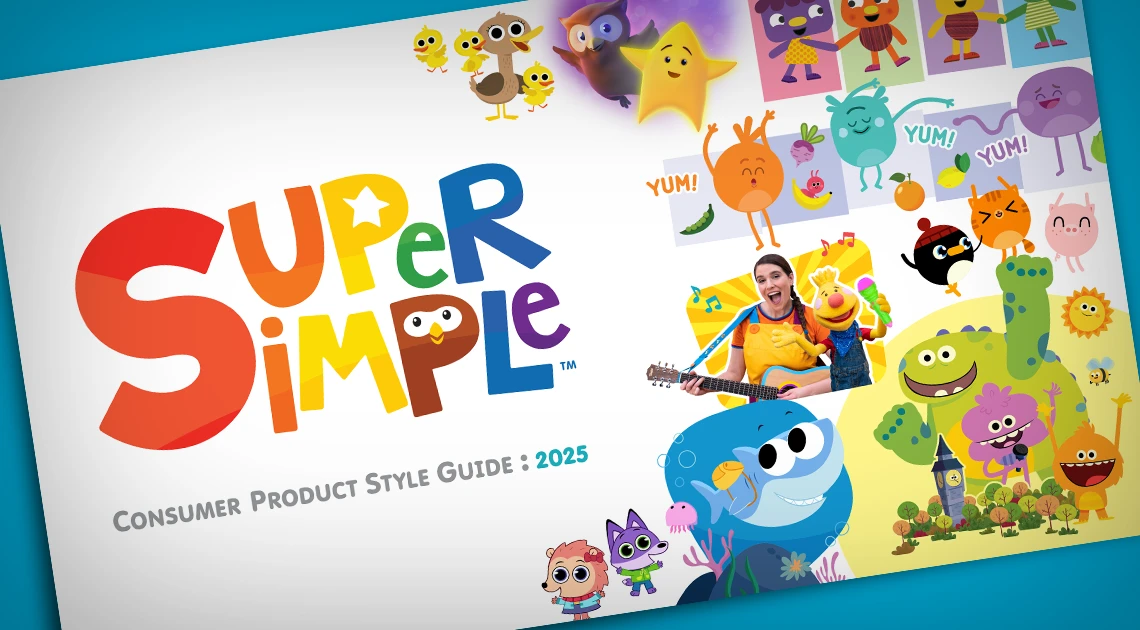
Super Simple is a beloved preschool content brand with global audience and billions of YouTube views. When Skyship Entertainment decided it was time to expand Super Simple’s reach into licensed consumer products, they realized they needed to develop a style guide. Their creative team attempted to build a guide on their own, but struggled to determine how best to present their complex mix of character groupings and popular content to licensees in a way that would translate well to licensed consumer products. Meanwhile, with high licensee interest, they were trying hard to stay on top of asset creation while working with partners on a case-by-case basis to develop product and packaging.
At this point, they decided to engage our team to create the Super Simple brand’s first-ever licensing program style guide – one that would translate their online success into a powerful foundation for brand licensing.
Through our pre-design research process, we uncovered the strongest visual cues and narrative elements that could seamlessly extend into consumer products. We then developed an extensive library of design elements centered around the brand’s most popular character groupings – The Bumble Nums, Noodle & Pals, Rhymington Square, Finny the Shark and the cast of characters from Super Simple Songs.
The result is a comprehensive product development toolkit that provides licensee partners with everything they need to bring the Super Simple brand to life at retail. The goal was to create a guide that delivers both inspiration and direction through an overarching brand aesthetic that promotes consistency throughout the entire product development process.
The Super Simple style guide enabled licensees to produce high-quality products more efficiently. It gave the internal team room to focus on the brand’s licensing strategy, not the approval process. And, it helped Super Simple show up with visual consistently at retail.
Recognize the signals: Know when to build a licensing program style guide that empowers your brand
A licensing program style guide is a framework that protects your IP as it scales, equips licensees with the tools they need to succeed, and ensures that your partners’ products will show up at retail with impact and visual consistency. But, timing matters. Build it too soon and it sits unused. Wait too long and you’re left cleaning up inconsistencies that could have been avoided.
The key? Recognize the signals. Growing licensee interest. Repeated questions to your creative team. Packaging that doesn’t align visually across consumer product categories. Those are the moments when a style guide shifts from “nice to have” to “absolutely neccesary.”
Design Force, Inc. specializes in licensing program style guide development for toy and entertainment brands. We help brand owners create comprehensive, easy-to-use toolkits that keep their IP consistent, their partners empowered, and their products aligned at retail. If you’re ready to take control of your licensing strategy, let’s talk about how we can help you build a style guide that sets your brand up for scalable success.