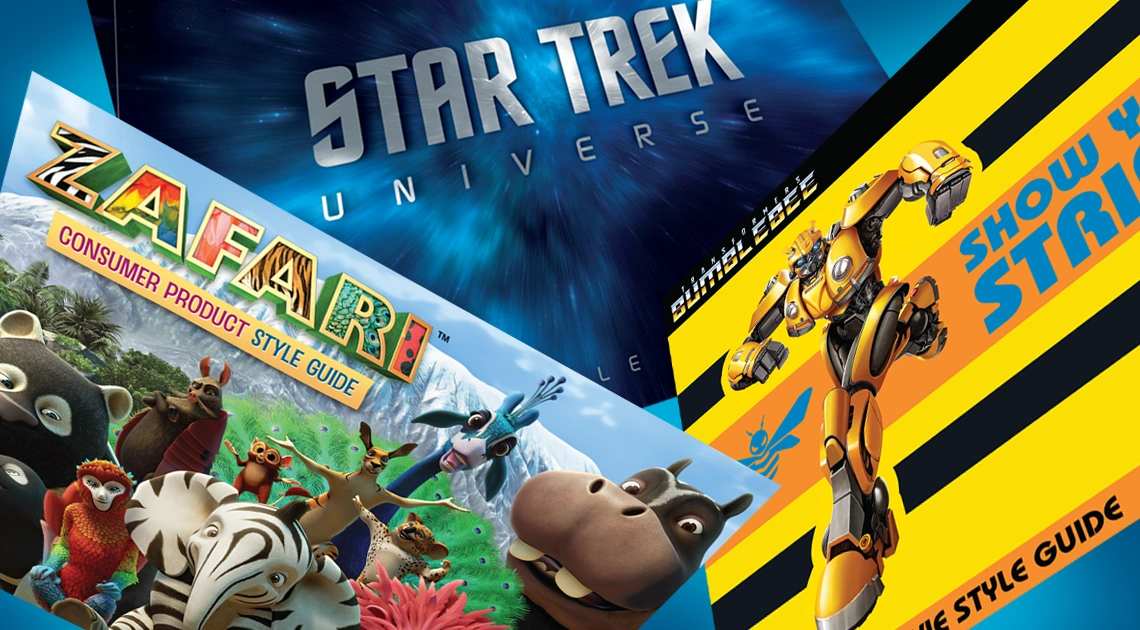
Breaking into the world of brand licensing can feel both exciting and overwhelming for a new entertainment property. There’s a rush to get products into the marketplace, meet fan interest, and build visibility. But before the first pitch deck is shared or the first licensee conversation begins, the smartest investment a brand can make is in the development of a consumer product style guide. It serves as the foundation upon which every product, every design decision, and every retail moment will grow. It also sets the tone for how partners will experience the brand long before it reaches shelves.
Many brand owners underestimate just how pivotal the style guide is in shaping the brand’s journey. A style guide is not simply a collection of visual assets. It is the brand’s world translated into an organized, thoughtful system. It shows how the brand looks, sounds, and behaves across consumer product categories. And, for entertainment properties in particular, it becomes the most influential storytelling tool outside of the brand’s original content. It is the guide that defines how fans will meet the brand through licensed consumer product, often for the very first time.
Why a style guide builds credibility with licensees
In brand licensing, confidence matters. Licensees need to believe in the brand before they commit resources to design, development, tooling, and retail distribution of their products. When a new property arrives with a complete style guide in place, licensees see a brand that understands what it means to show up consistently in the consumer product marketplace.
Licensees are constantly evaluating new IPs. Some are visually rich but lack commercial application. Others have strong stories but weak design systems. A style guide pulls these elements together into one cohesive presentation. It shows the brand’s design architecture, personality, assets, color logic, and key imagery. It introduces the characters in a manner that not only represents them accurately, but also sets the tone for how they should be interpreted in product form.
A well-structured style guide also removes guesswork, which is one of the most important factors for licensees. When they see robust character art, pose libraries, composed graphics, patterns, icons, and a comprehensive packaging program, they know the property can scale. Disney has mastered this approach with its evergreen franchises. From the earliest introductions of characters like Mickey Mouse to more modern rollouts such as the Frozen franchise, Disney relied on highly-organized, well-conceived and executed style guides to translate their brands’ worlds to licensed products quickly and consistently. Sanrio’s global success with Hello Kitty followed a similar path. Before the character became a cultural icon, Sanrio built a clear identity structure around her personality and visual rules, which licensees could adopt without hesitation.
These examples show something essential. Licensees gravitate toward brands that present themselves with clarity. They can move faster, design better, and hit retail with more confidence. A style guide makes this possible.
Why licensing agencies want brands with style guides in place
Licensing agencies are gatekeepers in the industry. They curate the brands they bring to market and choose partners that already demonstrate potential. A brand equipped with a strong style guide is easier to represent because the agency can immediately visualize the retail experience, understand positioning, and begin conversations with targeted licensee partners.
Agencies also know how much time is wasted when essential assets are missing or inconsistent. Without a style guide in place, they spend too much time chasing files, correcting artwork, or waiting for approvals. A style guide eliminates these barriers. It gives them a polished tool to pitch the brand in a compelling manner, whether they are presenting at trade shows, retailer meetings, or direct licensee conversations.
Agencies think in terms of opportunity. They want to know what the brand can become, not just what it is today. Style guides help them see the range of product possibilities. Seasonal artwork, logo variations, secondary characters, texture libraries, and packaging framework all serve as proof that the brand has depth. When agencies see this level of preparation, they know they can sell the vision effectively.
The power of brand consistency across consumer product categories
As a brand grows, the greatest challenge is maintaining consistency. Dozens of partners across global markets can interpret a brand in different ways. Without structure, the brand begins to drift. Color accuracy is lost. Character proportions shift. Logos are adapted incorrectly. Retailers notice, and consumers notice even more.
A style guide protects the brand against these issues. It creates order by defining how the brand lives on products. It also explains the logic behind each element. Rather than presenting assets in isolation, it shows how they work together to reinforce a single brand story.
Successful entertainment brands treat their style guides as living ecosystems. For SpongeBob SquarePants, Nickelodeon built a visual identity system that preserves the character’s iconic look with strict attention to lines, color, and expressions. Sesame Workshop developed clear systems that keep Elmo, Cookie Monster, and Big Bird recognizable across categories. This kind of consistency is not accidental. It is the result of thoughtful, disciplined style guide development.
When a new entertainment brand enters the licensing space, a style guide ensures that every partner supports the brand’s integrity. It allows the core story to stay intact even as the product mix expands.
How a style guide clarifies the brand from the inside out
Brand owners often discover something unexpected while developing a style guide. The process forces clarity. It brings definition to areas that may still feel conceptual or intuitive in the early stages.
Building the guide requires specifying tone, personality, visual rhythm, emotional attributes, and narrative intent. It means establishing color logic, building a consistent design language, developing design assets, capturing character traits, and articulating the visual voice of the brand’s world. These decisions crystallize the brand’s identity in a way that benefits not only licensees, but also internal teams.
Marketing, social, creative, and production teams all benefit from the same guidance. The style guide becomes a compass for everyone involved. It is the shared document that ensures the brand grows in a focused, meaningful direction.
Starting with a style guide sets the brand up for licensing success
For any entertainment property stepping into licensing for the first time, the style guide is not optional. It’s truly the foundation upon which every product expression will stand. Without it, the brand risks entering the marketplace with weak or inconsistent executions that can take years to correct. With it, the brand presents itself with strength, confidence, and visual authority.
It speeds conversations with partners. It inspires better, more innovative products that connect with consumers on an emotional level. It protects the brand’s world. And it signals that the property is ready to compete.
Build your licensing future on a solid creative foundation
A consumer product style guide is more than a tool for organization. It is an immersive experience that brings partners into the heart of the brand, showing them how characters, worlds, color logic, and visual language translate into meaningful licensed products. The strongest guides balance brand fidelity with commercial clarity. They protect the identity that makes the property compelling while giving licensees the structure and inspiration they need to build programs that resonate across categories.
At Design Force, Inc., we approach style guide development as both a creative and strategic discipline. Our work combines deep immersion in the brand’s storytelling universe with a clear understanding of how licensed products succeed at retail. From world building and character expression to package design and design elements development, every part of the guide is crafted to help the brand show up with purpose.
If your entertainment brand is ready to enter the licensing space with a style guide that elevates your identity and strengthens your commercial readiness, learn more by exploring our approach to style guide design.