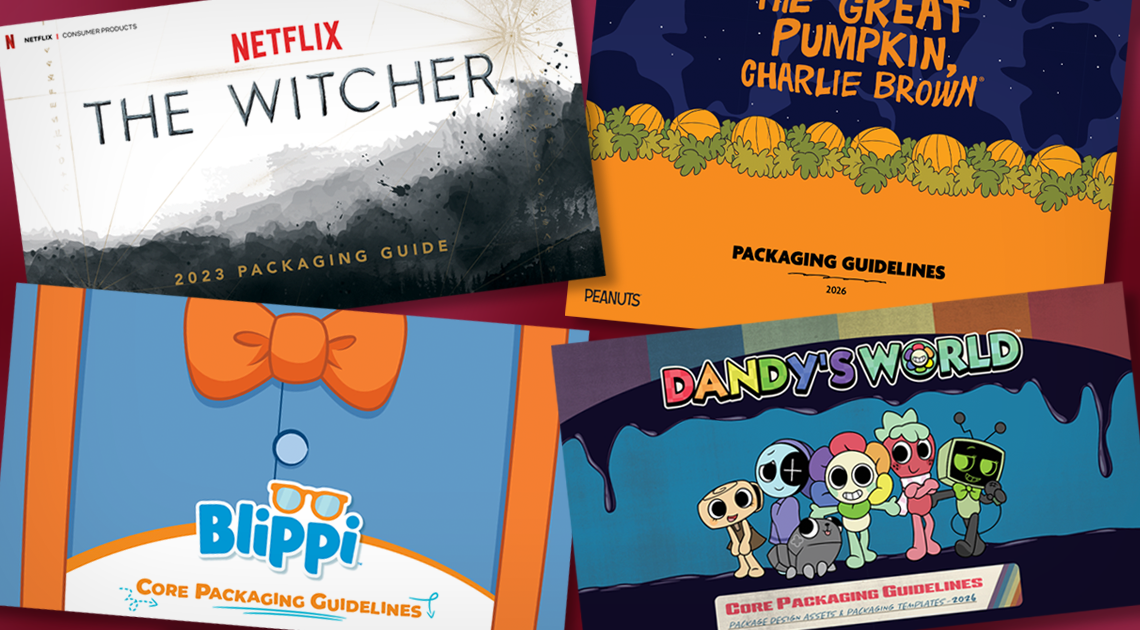
When a brand owner invests in developing a comprehensive licensed product packaging program, the objective is clear: to establish a recognizable, cohesive brand presence across a wide variety of consumer products, regardless of which licensee is responsible for bringing them to market. Thoughtfully developed package design architecture, supported by comprehensive packaging standardization guidelines, provides the creative foundation for accomplishing this.
But there’s another important consideration that deserves attention.
Once the guidelines have been distributed and licensees begin developing their packaging, who ensures that the resulting designs collectively deliver the intended brand experience?
The answer, of course, is the brand owner.
And while that responsibility may seem obvious, I believe there’s an important distinction between approving individual packaging submissions and overseeing the visual integrity of an entire licensed product packaging program.
Why packaging guidelines are the foundation of brand consistency
I’ve written extensively about the importance of establishing a cohesive package design architecture for licensed consumer products.
Our approach begins with developing a creative framework that establishes how a brand should be represented across its licensed product packaging. The objective is to create a distinctive visual identity that can accommodate different packaging formats and product categories while maintaining a recognizable brand presence.
Our proprietary approach to packaging standardization results in a comprehensive guidelines document organized into two sections.
The Package Design Assets section introduces the modular design components of the packaging system in the sequence licensees will use them to develop their packaging.
The Packaging Templates section then presents the individual packaging formats, with detailed call-outs that reference the Package Design Assets already introduced.
This deliberate structure helps licensees understand both the components of the system and how those components work together.
Rather than leaving each manufacturer to interpret the brand’s packaging identity independently, the guidelines provide a consistent creative framework for developing packaging across the licensing program.
It’s an essential investment in the brand’s retail presentation. However, even the most thoughtfully developed system requires informed oversight as it moves from established design direction to actual packaged merchandise.
The difference between individual approvals and collective brand presentation
Consider a brand owner managing packaging submissions from several licensees. One manufacturer is developing packaging for toys. Another is preparing a stationery assortment. Others are working on accessories, seasonal merchandise and home products.
Each licensee receives the same packaging standardization guidelines document and develops its packaging using the approved assets and applicable templates.
As submissions arrive, the brand owner’s creative or licensing team reviews them for compliance with the established system. Individually, the packages may appear entirely acceptable. But what happens when they’re viewed together?
Perhaps one licensee has consistently featured certain Package Design Assets more prominently than others. Another has favored a more restrained composition. A third needed to adapt the templates to an unusual packaging format that wasn’t specifically illustrated in the guidelines.
These differences may be perfectly appropriate within their respective categories. The question is whether the resulting assortment still communicates the cohesive visual identity envisioned when the packaging standardization was established.
And that’s a question that can’t always be answered by reviewing each submission independently.
Evaluating licensed product packaging as a complete visual system
One practice I believe brand owners should consider is periodically reviewing packaging submissions collectively, rather than exclusively within their individual product categories.
This doesn’t necessarily require an elaborate new approval procedure. It might simply involve assembling approved packaging and current submissions into a single visual presentation, allowing the creative team to evaluate how the different applications relate to one another. When viewed collectively, subtle inconsistencies can become much more apparent.
Are the brand’s most recognizable visual elements maintaining their intended prominence? Are the relationships between characters, supporting graphics and product imagery consistent with the established design direction? Do the different packaging formats feel like members of the same visual family? Just as importantly, are the variations among products contributing to a more interesting retail presentation, or are they gradually weakening the brand’s identity?
These are creative judgments that extend beyond checking whether the correct assets and templates have been used.
The objective isn’t to make every package look identical. A window box, blister card, tray box and hangtag will naturally present different design challenges. The objective is to ensure that those different applications continue to express the same underlying brand identity.
When creative oversight strengthens the packaging guidelines
There’s another benefit to evaluating packaging across an entire licensing program. It provides brand owners with an opportunity to recognize how their package design system performs in actual applications.
A licensee may develop an especially effective adaptation of an approved template for a previously unanticipated package format. Another may discover an interesting way to combine modular design assets while remaining faithful to the established creative direction.
These applications can demonstrate the versatility of a well-developed package design architecture.
Conversely, when similar inconsistencies appear repeatedly across multiple licensees, they may reveal an opportunity to clarify a particular aspect of the packaging standardization guidelines. However, that doesn’t mean the guidelines should be continually revised to accommodate every creative interpretation.
A comprehensive packaging system should provide sufficient direction to minimize unnecessary revisions and allow licensees to work confidently within its established parameters.
But licensing programs evolve. New product categories emerge, packaging formats change and opportunities arise that may not have been anticipated during the original development process. Thoughtful creative oversight helps brand owners distinguish between appropriate adaptations of the system and situations that warrant additional direction.
The brand owner’s responsibility doesn’t end with approval
Ultimately, individual licensees are responsible for developing packaging that meets the requirements of their products while adhering to the brand owner’s established packaging system. But no individual licensee has the same perspective as the brand owner.
Licensees generally see the packaging they’re developing for their own product categories. The brand owner has visibility across the entire licensing program and is uniquely positioned to evaluate how those individual efforts contribute to the brand’s overall retail presence. That’s why I believe maintaining consistency requires more than reviewing submissions against the guidelines. It requires occasionally looking beyond the individual package to consider the collective impression being created across all licensed merchandise.
Strong package design architecture and comprehensive packaging standardization guidelines make that responsibility considerably more manageable. They establish the creative direction, provide the necessary tools and create a common visual language for licensees to follow.
The brand owner’s ongoing oversight ensures that the original vision remains intact as the program grows.
At Design Force, Inc., our Licensed Product Package Design services help brand owners establish that foundation through strategic package design architecture and carefully structured packaging standardization guidelines. By giving licensees a clear, cohesive system to work within, we help make it possible for brands to maintain a distinctive and recognizable presence across the consumer products marketplace.
Because the ultimate measure of a successful licensed packaging program isn’t simply how well each individual package follows the guidelines. It’s how effectively all those packages work together to represent the brand.